
14-04-2026
ISO 3941:2026 Fire type classification update
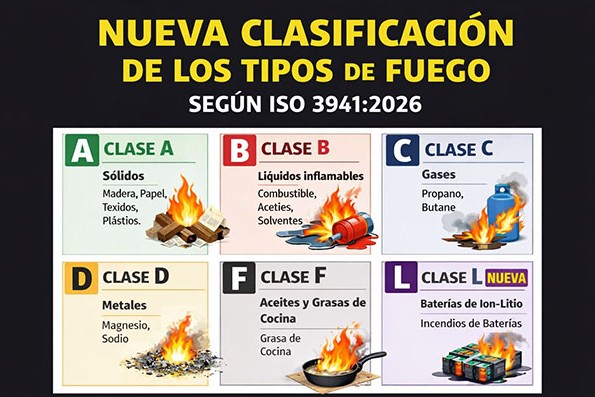
With the recent publication of ISO 3941:2026, the classification of fire types is as follows:
- Class A: Organic solids (wood, paper, fabrics, embers).
- Class B: Flammable liquids (gasoline, alcohol, paraffins).
- Class C: Flammable gases (butane, propane, methane).
- Class D: Combustible metals (magnesium, sodium, aluminum).
- Class F/K: Cooking oils and fats.
- Class L (NEW): Electrochemical fires derived from lithium batteries (scooters, bicycles, mobile phones).
It has been added a new one, Class L for fires involving lithium-ion batteries. This new category addresses the challenges of electro mobility and energy storage, characterized by high energy density and thermal runaway . The traditional classes A, B, C, D, and F are maintained, with updated criteria.
Why a new class? These fires have been determined to be electrochemical. Unlike traditional classes (A, B, C…), Class L fires have a much higher energy density and an explosively rapid fire growth rate (FGR), necessitating a more advanced approach to prevention and suppression techniques. Of particular interest are aspects such as the need for prolonged cooling, which is more crucial than initial extinguishment, and the potential for the release of highly toxic gases.
If we think in terms of Occupational Risk Prevention, the technicians who collaborate with companies where fires of this type, which are becoming increasingly frequent, may occur, must properly carry out the review of the mandatory risk assessment, emergency measures (Art 20 ), as well as the corresponding Preventive Planning, in addition to adapting the content of the training to the workers.
At ERGASIA we have already implemented these changes in our technical structure so that all our clients can stay up to date.


